 English
Blog


2026-10-10 15:43:24
A Full Body Work Harness is an important part of personal fall protection equipment used in construction, maintenance, roofing, and other jobs performed at height. Whether workers are required to wear one depends on the applicable safety regulations, the working environment, the risk of falling, and the type of fall protection system provided. In many situations, a full body safety harness is required when workers are exposed to fall hazards and other compliant protection methods are not sufficient or practical.
However, working at height does not automatically mean that every worker must use the same type of harness. Employers need to assess workplace hazards, select appropriate protective equipment, and ensure that workers understand how to use it correctly.
A Full Body Work Harness may be required when workers perform tasks on elevated platforms, roofs, scaffolding, structural steel, or other locations where a fall could cause serious injury. Requirements vary by country, industry, and working conditions. Employers should consult the relevant occupational safety regulations before deciding which protective measures are necessary.
Common situations where fall protection may be needed include:
Construction work: Workers installing structural components, working near unprotected edges, or performing elevated building tasks may need an approved fall protection system.
Roof maintenance: Workers repairing roofing materials, inspecting drainage systems, or installing rooftop equipment may face fall hazards near roof edges or fragile surfaces.
Industrial maintenance: Employees servicing machinery, overhead equipment, or elevated production facilities may require a suitable work safety harness and compatible fall protection equipment.
Telecommunications work: Workers accessing towers and other elevated structures may need specialized fall protection systems designed for their tasks.
Elevated platform operations: Certain mobile elevating work platforms require personal fall protection equipment according to applicable regulations and manufacturer instructions.
The required protection depends on the actual hazard and the governing safety rules. A properly selected fall protection harness should be part of a complete system rather than treated as an independent solution.
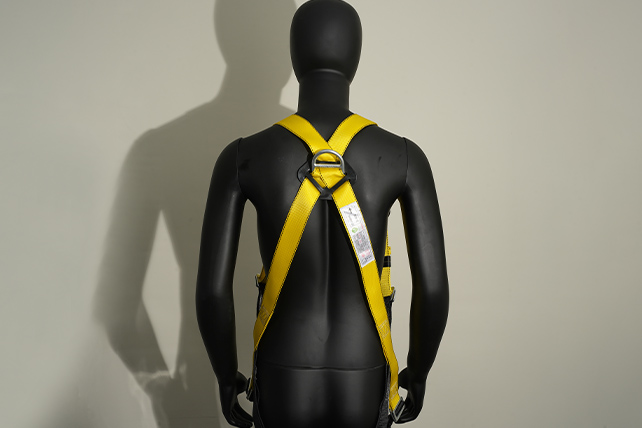
A full body safety harness distributes the forces associated with a fall across appropriate parts of the body when used as part of a compatible fall arrest system. It typically includes shoulder straps, leg straps, a chest strap, adjustment buckles, and designated attachment points.
When connected to a suitable anchorage through compatible equipment, the harness helps secure the worker if a fall occurs. Depending on the application, the complete system may include an anchorage connector, a lanyard, an energy absorber, or a self-retracting lifeline.
A safety work harness may also be used in positioning or restraint applications when it is specifically designed and configured for that purpose. The selected system must match the work activity, potential fall distance, and applicable safety requirements.
It is important to understand that a harness alone does not prevent every fall. Proper anchorage, compatible connecting equipment, adequate clearance, correct fitting, and worker training are all essential to effective fall protection.
No single height threshold applies to every workplace and every country. Fall protection requirements depend on the applicable regulations, the type of work, and the conditions surrounding the worker.
For example, regulations may establish different requirements for construction sites, general industry, scaffolding, ladders, and aerial work platforms. Some tasks require protection at relatively low heights because of the nature of the hazard, while other situations may be governed by specific exceptions or alternative protective measures.
In the United States, OSHA requirements differ between construction and general industry. Construction regulations under 29 CFR 1926.501 establish specific circumstances in which fall protection is required, while general industry requirements are addressed under 29 CFR 1910 Subpart D. The applicable provision should be checked for the particular task rather than relying on a single universal height limit.
Employers should identify the relevant standard before determining whether a Full Body Harness, guardrail system, safety net, travel restraint system, or another compliant method is appropriate.
In some situations, yes. A Full Body Work Harness is not necessarily the first or only fall protection option. Depending on the workplace and applicable regulations, other systems may provide suitable protection.
Guardrails: Properly installed guardrails provide a physical barrier that helps prevent workers from reaching an unprotected edge.
Safety nets: Approved safety net systems may be used in certain construction applications to reduce the consequences of a fall.
Travel restraint systems: These systems limit worker movement so the worker cannot reach a hazardous edge when properly designed and used.
Personal fall arrest systems: These systems use a harness and compatible equipment to stop a fall after it begins.
The appropriate option depends on the task, site conditions, and legal requirements. Employers should prioritize effective collective protection where required or appropriate and use personal protective equipment as part of a comprehensive safety plan.
Selecting a work safety harness involves more than checking its appearance or price. The harness must be suitable for the intended application and compatible with the rest of the fall protection system.
Consider the following factors before selecting a full body harness:
Intended application: Confirm whether the harness is designed for construction, industrial maintenance, roofing, tower work, or another specific activity.
Correct fit: Choose a suitable size and ensure that shoulder, chest, and leg straps can be adjusted according to the manufacturer's instructions.
Attachment points: Verify that the harness has the attachment points required for the intended fall arrest, restraint, or positioning application.
System compatibility: Confirm that connectors, lanyards, lifelines, and anchorage components are compatible with the harness.
Applicable standards: Check the relevant certifications, labels, instructions, and regulatory requirements for the country where the equipment will be used.
Environmental conditions: Consider exposure to chemicals, heat, moisture, sharp edges, and other conditions that may affect equipment performance.
A suitable fall protection harness should be selected based on documented requirements and a workplace hazard assessment, not simply because it is described as a universal safety product.
Pre-use inspection helps identify damage or defects that could compromise the equipment. Workers should inspect their full body safety harness before each use and follow any additional inspection schedule specified by the manufacturer or employer.
Important inspection points include:
Check webbing for cuts, fraying, burns, chemical damage, excessive wear, or other deterioration.
Inspect stitching for loose threads, broken seams, or visible damage.
Check buckles and adjustment hardware for deformation, corrosion, cracks, or improper operation.
Examine D-rings and other attachment points for damage or distortion.
Confirm that labels and identification information remain readable.
Look for evidence of a previous fall arrest or any other event that may have compromised the equipment.
Remove damaged or suspect equipment from service and follow the manufacturer's instructions for evaluation, repair, or replacement. A harness that has arrested a fall should not be returned to service unless the applicable instructions and qualified evaluation procedures explicitly permit it.
Workers need practical instruction on fitting, adjustment, connection, inspection, and emergency procedures. Training should explain how the complete fall protection system works and how to recognize hazards associated with the task.
For personal fall arrest systems, workers should understand anchorage selection, fall clearance, swing-fall hazards, and the importance of prompt rescue planning. Employers must also meet any training and competency requirements established by the applicable regulations.
Correct training helps workers avoid common mistakes, such as attaching equipment to an unsuitable anchorage, using incompatible connectors, leaving straps excessively loose, or failing to consider the clearance required below a working surface.
A Full Body Work Harness is required in many elevated work situations where regulations mandate personal fall protection and other suitable methods do not provide the required protection. However, the exact requirements depend on the work activity, location, and applicable safety standards.
Employers should assess fall hazards, select suitable protective systems, provide proper training, and establish inspection and rescue procedures. By treating the harness as one component of a complete fall protection system, workplaces can improve safety and help workers perform elevated tasks more confidently.
```

Aplexus Industrial Co.,Ltd Is a trusted provider of semi-finished accessories and personal protective equipment (PPE).

Business wechat
Copyright © 2026 Aplexus Industrial Co.,Ltd All rights reserved.


