 English
Blog


2026-10-31 16:16:54
Webbing density is an important factor in determining the strength, stability, and durability of a tactical belt. It describes how closely the yarns are arranged within the woven structure, usually measured by warp ends and weft picks per unit of length. A higher webbing density can create a tighter, more stable construction, helping the belt resist deformation, distribute loads, and maintain its shape during repeated use. However, density alone does not determine the final strength. Yarn material, denier, weave pattern, finishing treatment, belt width, and stitching quality all influence performance.
For military equipment distributors, law enforcement suppliers, outdoor gear wholesalers, and other B2B buyers, understanding webbing density is essential when comparing Tactical Gears. A tactical belt may need to support holsters, magazine pouches, utility tools, and other accessories while remaining comfortable and adjustable. The right webbing construction must balance tensile strength, flexibility, abrasion resistance, and long-term dimensional stability.
Webbing density affects tactical belt strength by influencing how many yarns participate in carrying and distributing an applied load. In woven Nylon Webbing, warp yarns generally run along the belt's length, while weft yarns cross its width. The number of yarns in each direction, combined with their thickness and arrangement, determines the fabric's structural characteristics.
When warp density increases, more longitudinal yarns may contribute to resisting tension along the belt. This can improve load distribution and reduce the likelihood that individual yarns become excessively stressed. When weft density increases, the webbing may become more compact across its width, helping maintain its shape and resist edge distortion. These effects depend on yarn specifications and weave construction rather than density alone.
Consider two nylon webbings made from yarns of the same material and similar denier. If one uses a more compact weave, it may show better resistance to yarn displacement and local deformation. However, the denser sample is not automatically stronger in every tensile test. Excessive density can restrict yarn movement, increase stiffness, and affect how the material responds to repeated bending.
For a tactical belt carrying several accessories, this balance matters. The webbing must resist longitudinal pulling forces while maintaining enough flexibility to wrap around the waist, pass through belt loops, and accommodate adjustment hardware. A suitable density helps the belt retain its structure without making it unnecessarily rigid.
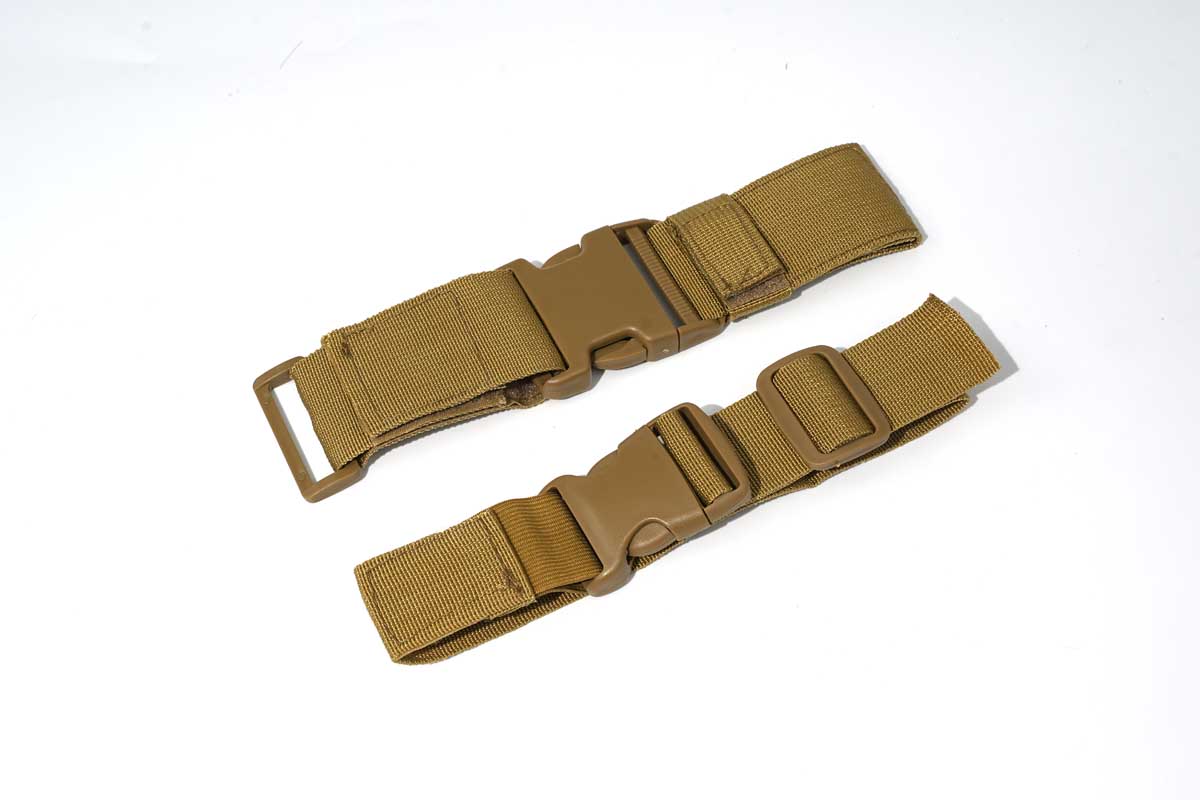
Webbing density influences several performance characteristics that directly affect product quality and service life.
A well-designed woven structure distributes tension across multiple yarns instead of concentrating stress in a small area. This is particularly important when a tactical belt supports accessories that create localized pulling forces. For example, a holster attached to one side of the belt can produce uneven loading during movement. If the webbing structure is inconsistent, individual yarns may shift or become overloaded, increasing the risk of deformation.
However, the actual breaking strength also depends on fiber properties, yarn construction, and weave design. High-tenacity nylon yarns with suitable denier can provide substantial tensile performance, while poor-quality yarns may limit the benefit of a dense weave.
Tactical Belts are frequently bent, tightened, loosened, and exposed to equipment pressure. Webbing with a stable construction is less likely to develop uneven stretching, twisting, or permanent distortion during normal use.
Density helps control the spacing and interaction between warp and weft yarns. If the weave is too loose, yarns may move more easily under friction or tension. This can lead to uneven edges, local thinning, or changes in belt dimensions. A controlled density helps the manufacturer maintain consistent width and thickness throughout production.
Tactical belts frequently contact metal buckles, hook-and-loop panels, holster attachments, and other accessories. Repeated friction can damage exposed fibers and gradually weaken the webbing.
A compact weave can help limit yarn displacement and reduce gaps where friction may catch individual filaments. Nevertheless, abrasion resistance also depends on fiber type, surface finish, yarn twist, and the contact material. Buyers should therefore evaluate abrasion performance through testing rather than assuming that a higher density guarantees better wear resistance.
No. Higher webbing density does not automatically produce a stronger tactical belt. Density is only one part of the material specification, and increasing it without adjusting other construction parameters can create disadvantages.
For example, a dense webbing made with low-strength yarn may still have limited breaking strength. A less dense construction using high-tenacity nylon yarns and an appropriate weave may deliver better tensile performance. Similarly, excessive density can make the belt too stiff for comfortable adjustment or repeated bending.
Manufacturers must balance several variables:
Fiber material: Nylon is commonly selected for tactical webbing because of its strength, flexibility, and abrasion resistance. The specific nylon grade and yarn quality affect performance.
Yarn denier: Denier indicates the linear mass of a yarn. Higher-denier yarns are generally thicker, but actual strength also depends on fiber quality and yarn construction.
Warp and weft density: These values describe yarn arrangement in each direction and should be specified separately.
Weave pattern: Plain, twill, and other constructions create different levels of interlacing, flexibility, and surface characteristics.
Finishing treatment: Coatings and other finishing processes can affect abrasion resistance, water behavior, stiffness, and dimensional stability.
For B2B procurement, the practical approach is to request complete webbing specifications and test results rather than selecting products based on density figures alone. A reliable Tactical Gears manufacturer should be able to explain how the selected yarn, weave, and density meet the intended application requirements.
Buyers should evaluate the finished webbing through measurable quality indicators. A density specification describes the construction, but tensile and durability tests show how the material performs under controlled conditions.
Ask the supplier to provide the number of warp ends and weft picks per unit of length. These measurements should be recorded consistently, such as ends per inch and picks per inch. Comparing products without using the same measurement units or inspection method can lead to misleading conclusions.
During incoming inspection, take samples from different positions within the same production lot. Check whether the yarn arrangement remains consistent across the webbing width and along its length. Significant variation may indicate problems with loom settings, yarn feeding, or production control.
Breaking strength measures the maximum tensile force a webbing sample withstands before failure. Elongation measures how much it extends under tensile loading. Both results matter because a tactical belt needs to resist pulling forces without excessive deformation.
ASTM D6775 provides a test method for determining the breaking strength and elongation of textile webbing, tape, and braided materials using a split-drum specimen clamp. It can be used for acceptance testing of commercial shipments, provided that the test conditions and sample specifications are clearly defined.
For procurement comparisons, buyers should request the test method, specimen dimensions, conditioning conditions, test results, and failure observations. Results from different laboratories or different test setups should not be compared without checking whether the procedures are equivalent.
A webbing sample may achieve a satisfactory breaking-strength result but still perform poorly after repeated friction. Buyers should therefore consider abrasion testing and repeated bending or adjustment evaluations where relevant to the intended application.
For example, a tactical belt used with metal attachment hardware may experience repeated friction around buckle contact points and accessory interfaces. Inspecting the webbing after controlled abrasion can reveal surface fuzzing, broken filaments, yarn displacement, and edge damage.
Yes. Webbing density influences how a tactical belt bends, conforms to the waist, and interacts with equipment. A very loose construction may feel flexible initially but can deform more easily under repeated loading. A very compact construction may retain its shape but feel stiff, particularly when the belt is worn for extended periods.
For example, a duty belt designed to carry multiple accessories needs enough structural support to prevent excessive sagging. At the same time, it must remain adjustable and comfortable when the wearer sits, walks, or changes position. An overly rigid webbing construction can create pressure points and make adjustment less convenient.
Manufacturers can manage this balance by selecting suitable yarn denier, weave structure, and density instead of simply maximizing the number of yarns. The finished belt should also be evaluated with its actual buckle, inner belt, hook-and-loop components, and accessory attachments because these parts influence overall stiffness.
Webbing density can contribute to long-term durability by helping the woven structure maintain its integrity under repeated tension and friction. When yarns are properly arranged and secured, the webbing is less likely to experience excessive movement between yarns or localized deformation.
Consider a belt used for daily law enforcement duty. It may be tightened and loosened repeatedly, loaded with equipment, and exposed to moisture, dust, and friction from accessories. Over time, these conditions can affect yarn surfaces, stitching, and adjustment points.
A suitable density can help maintain the webbing structure, but it cannot prevent every form of wear. Nylon grade, UV exposure, moisture, contamination, cleaning practices, and hardware design also affect service life. Buyers should evaluate the complete belt rather than treating webbing density as a standalone durability guarantee.
During quality inspection, pay particular attention to:
Broken or pulled yarns along the belt surface.
Uneven webbing width, thickness, or edge construction.
Permanent stretching after repeated loading.
Fraying around buckle slots and attachment points.
Loose stitching or separation between webbing layers.
When sourcing Tactical Gears for wholesale distribution, government supply, or private-label programs, buyers should request more than a product photograph and a general strength claim. A professional supplier should provide technical details that allow the buyer to compare products and verify manufacturing consistency.
Useful procurement questions include:
What nylon material and yarn denier are used in the webbing?
What are the warp and weft density specifications?
Which weave construction is used, and why was it selected?
What is the measured breaking strength and elongation?
Are abrasion resistance and dimensional stability evaluated?
How are webbing width, thickness, color, and density controlled during production?
Are finished belts inspected for stitching strength, buckle security, and attachment stability?
Can the manufacturer provide samples and batch inspection records?
These questions help buyers identify whether a supplier has a controlled manufacturing process or simply purchases standard webbing and assembles it into finished products. For OEM and ODM projects, confirming the material specification before mass production is particularly important. Changes in yarn, density, weave, or finishing can affect both product performance and production consistency.
Consistent webbing density begins with raw material inspection and continues throughout weaving, finishing, cutting, and assembly. Even when a manufacturer uses the same nominal yarn specification, variations in yarn tension or loom settings can create differences between production batches.
During weaving, the manufacturer needs to control warp tension, weft insertion, loom speed, and fabric take-up. Incorrect tension can produce uneven density, width variation, or distorted edges. Regular inspection helps identify these problems before the material moves to the next production stage.
After weaving, finishing treatments must be controlled to avoid excessive stiffness, uneven coating, or unwanted changes in dimensions. The webbing should then be checked for appearance, width, thickness, density, and relevant performance requirements.
During final assembly, the belt's stitching pattern, reinforcement points, buckle connection, and accessory interfaces also require inspection. A strong webbing material cannot compensate for weak stitching or poorly secured hardware. Therefore, quality assurance should cover both the raw webbing and the completed tactical belt.
Webbing density is an important design variable in tactical belt manufacturing because it influences load distribution, shape retention, flexibility, and resistance to yarn displacement. A higher density can improve structural stability when combined with suitable yarn strength and weave construction, but it should not be treated as a direct substitute for tensile testing.
For overseas wholesalers, importers, and professional equipment distributors, the best purchasing decision comes from evaluating the complete specification: material, denier, warp and weft density, weave pattern, finishing treatment, breaking strength, elongation, and finished-belt assembly quality.
When sourcing Tactical Gears, work with a manufacturer that can explain its material selection, provide consistent production specifications, and support quality verification with relevant test records. This approach helps buyers reduce product inconsistency, make more reliable supplier comparisons, and select tactical belts suited to their intended applications.

Aplexus Industrial Co.,Ltd Is a trusted provider of semi-finished accessories and personal protective equipment (PPE).

Business wechat
Copyright © 2026 Aplexus Industrial Co.,Ltd All rights reserved.


