 English
Blog


2026-10-24 11:39:32
Load-bearing stitching is one of the most critical factors affecting the strength and durability of a Full Body Harness. It connects webbing sections, secures attachment points, and transfers forces through the harness when a worker experiences a fall. Even when high-strength webbing and metal hardware are used, poorly designed or incorrectly manufactured stitching can become a weak point in the complete assembly.
For safety equipment distributors, industrial buyers, and OEM procurement teams, evaluating stitching quality requires more than checking the appearance of the seams. Thread selection, stitch pattern, sewing tension, seam geometry, manufacturing consistency, and finished-product testing all influence performance. Understanding these factors helps buyers assess product reliability and identify a qualified supplier.
During a fall-arrest event, a Full Body Harness transfers forces from the worker's body through the webbing, stitched connections, attachment points, and compatible fall-protection system. Load-bearing seams must distribute these forces without premature thread rupture, excessive webbing damage, or progressive seam separation.
The strength of a stitched joint depends on how effectively its threads engage the webbing and distribute the applied load. If the load is concentrated on a small number of stitches, local stress can increase. A seam with an appropriate pattern and geometry distributes force across a larger area, helping reduce localized damage.
However, stitch appearance alone cannot establish seam strength. Two seams that look similar may perform differently because of thread properties, needle damage, stitch density, sewing tension, and webbing construction. The complete harness assembly must therefore be evaluated under the applicable performance requirements.
Load-bearing harness seams may use box stitching, bar tacks, or other engineered patterns, depending on the joint design and manufacturer's validated specifications. Each pattern creates a different arrangement of thread paths and load-transfer points.
Box stitching can distribute loads across a defined rectangular area, while bar tacks concentrate multiple reinforcing stitches within a smaller region. Neither pattern is universally superior. The appropriate design depends on webbing width, attachment geometry, expected loading direction, thread characteristics, and verified test results.
Stitch density also requires careful control. Too few stitches may provide insufficient engagement, while excessive density can create closely spaced needle holes that weaken the webbing. Additional stitches do not automatically produce a stronger joint if they damage the load-bearing fibers or create uneven tension.
During Full Body Harness manufacturing, stitch pattern and density should be established through engineering validation rather than operator preference. Production specifications should define the approved pattern, stitch count or density, seam dimensions, and acceptable variation. Changes to these parameters require appropriate evaluation before implementation.
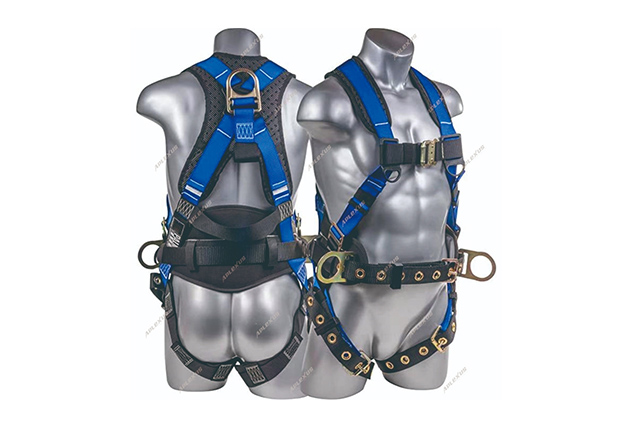
Sewing thread must withstand the mechanical demands of the joint while remaining compatible with the webbing and sewing process. Tensile strength, abrasion resistance, elongation, environmental resistance, and dimensional consistency all influence seam performance.
A thread that is unsuitable for the application may break under load, deteriorate after environmental exposure, or fail to maintain the intended seam structure. Thread performance also depends on the needle, stitch formation, and interaction between the thread and webbing fibers.
Sewing tension is equally important. Excessive tension can compress or damage webbing and pull stitches too tightly into the material. Insufficient tension may produce loose loops, inconsistent stitch formation, or seams that do not hold their intended geometry. Both conditions can reduce repeatability across production batches.
Manufacturers should qualify thread specifications, control sewing-machine settings, and inspect representative seams during production. Thread substitutions, needle changes, and adjustments to machine tension should be documented and evaluated because seemingly minor process changes can affect the finished joint.
Stitching creates needle penetrations in the webbing. If needle size, point type, alignment, or condition is unsuitable, the sewing process may cut or damage load-bearing fibers. Repeated penetrations in a narrow area can create a weakened zone even when the seam appears neat.
Webbing preparation also affects consistency. Incorrect alignment, folded material, contamination, frayed edges, or inconsistent overlap can change how forces travel through the joint. If the webbing is positioned incorrectly, the finished seam may not match the geometry used during design validation.
During production, operators should use approved needles and machine settings, maintain accurate alignment, and follow documented handling procedures. Inspection should identify skipped stitches, broken threads, damaged fibers, uneven rows, and deviations from the specified seam dimensions.
Where a defect could compromise a load-bearing connection, the affected assembly should be handled according to the manufacturer's documented nonconformance procedure. Cosmetic repairs should never be assumed to restore structural strength without an approved and validated process.
A harness design may perform well in initial testing but deliver inconsistent results if the sewing process varies between operators, machines, or production batches. Reliable full body harness manufacturing therefore requires controlled procedures and repeatable inspection criteria.
Machine calibration and preventive maintenance help maintain consistent stitch formation. Worn needles, damaged feed mechanisms, unstable thread tension, and incorrect machine settings can produce defects that are difficult to identify through visual inspection alone.
Operator training is another important control. Workers must understand approved seam specifications, material orientation, defect criteria, and procedures for handling nonconforming products. Clear work instructions reduce dependence on individual judgment and improve production repeatability.
Incoming inspection should verify webbing and thread specifications, while in-process inspection checks seam geometry and stitching defects. Production records should support traceability of materials, manufacturing batches, inspection results, and relevant process changes.
Load-bearing stitching must retain its intended performance throughout the conditions specified for the harness. Ultraviolet exposure, moisture, heat, abrasion, dirt, and certain chemicals can affect thread or webbing properties, depending on the materials used.
Environmental exposure may reduce thread strength, alter material flexibility, or increase wear around stitch holes. Repeated bending and friction can also damage exposed thread, particularly at contact points or locations where the harness rubs against equipment.
Durability evaluation should consider the intended work environment and the manufacturer's stated limitations. Where relevant, qualification testing can assess material and seam performance after specified conditioning or abrasion exposure. Results should be interpreted alongside the applicable harness requirements rather than treated as a universal prediction of service life.
Manufacturers should also provide clear inspection and retirement guidance. Visible fraying, broken stitches, damaged webbing, chemical contamination, or evidence of fall loading requires action according to the product instructions and applicable safety requirements.
Visual inspection is useful for identifying obvious defects, but it cannot establish the ultimate strength of a load-bearing seam. A reliable quality program combines process inspection with mechanical testing of representative materials, joints, and finished harness assemblies.
Seam tensile testing evaluates how a stitched joint responds to an applied load. Depending on the test method, results can reveal thread rupture, stitch pull-through, webbing failure, or progressive seam separation. The fixture, loading direction, specimen preparation, and test procedure must be appropriate for the joint being evaluated.
Finished-harness testing evaluates the complete assembly rather than an isolated seam. This is important because overall performance also depends on webbing configuration, hardware, attachment points, and the interaction between components.
In-process inspection checks stitch pattern, density, alignment, thread condition, and seam dimensions. These checks help identify production deviations before the finished product reaches final inspection.
Testing should follow the applicable product standard and documented validation plan. For fall-arrest Harnesses, buyers should request relevant compliance documentation and confirm that the product configuration being supplied matches the configuration evaluated during testing. Passing a sample seam test alone does not establish that an entire harness model is compliant.
When evaluating a full body harness manufacturer, procurement teams should assess the supplier's ability to maintain consistent stitching quality, demonstrate product compliance, and control manufacturing changes.
Stitching specifications: Ask how seam patterns, thread types, and sewing parameters are established and controlled.
Quality inspection: Confirm how skipped stitches, broken threads, needle damage, and dimensional deviations are detected.
Mechanical testing: Request relevant seam and finished-product test documentation.
Material traceability: Check whether webbing, thread, and finished-product batches can be traced through production records.
Change management: Verify how thread substitutions, machine-setting changes, and design modifications are assessed.
Compliance documentation: Confirm that the supplied model meets the applicable requirements for its intended market and application.
Buyers should also distinguish between a supplier's general quality claims and evidence supporting the specific product being purchased. Documented procedures, relevant test reports, and consistent production records provide a more useful basis for supplier evaluation than seam appearance alone.
Load-bearing stitching directly affects how a Full Body Harness transfers force, resists damage, and maintains structural integrity. Stitch pattern, density, thread selection, sewing tension, needle condition, and webbing preparation all contribute to seam performance. Their effectiveness depends on a validated design and consistent manufacturing execution.
For B2B buyers, a reliable supplier should demonstrate controlled sewing processes, appropriate inspection methods, mechanical testing, and traceable quality records. Evaluating these factors helps procurement teams make better-informed decisions when sourcing harnesses for professional fall-protection applications.

Aplexus Industrial Co.,Ltd Is a trusted provider of semi-finished accessories and personal protective equipment (PPE).

Business wechat
Copyright © 2026 Aplexus Industrial Co.,Ltd All rights reserved.


