 English
Blog


2026-09-15 13:35:13
The D-ring on a Safety Harness provides a designated connection point for compatible fall protection equipment, such as a lanyard, self-retracting lifeline, or other approved connecting device. On a Full Body Safety Harness, the rear dorsal D-ring is commonly used for fall arrest, while other D-rings may support work positioning, restraint, or rescue applications depending on the harness design. The D-ring itself is only one part of the protection system; its position, rated use, attachment method, and compatibility with the connecting equipment must all be considered.
For B2B buyers, understanding the purpose of each Safety Harness D-Ring is important when selecting equipment for construction, maintenance, tower work, industrial access, and other working-at-height applications. A harness may look similar from the outside while having substantially different connection configurations and intended uses.
A D-ring is a load-bearing connector integrated into a safety harness. It is normally made from high-strength metal and designed to provide a secure interface between the harness and an approved connecting device.
The name comes from its traditional D-shaped profile. This shape provides a practical connection point while allowing the connector to work with compatible hooks, carabiners, lifelines, or lanyards.
In a Fall Protection Harness, the D-ring must be securely connected to the harness structure rather than simply attached to the outer fabric. The load from a fall or positioning operation needs to be transferred through the webbing and reinforced construction of the harness.
The main function of a D-ring is to provide a controlled attachment point between the worker's harness and the rest of the fall protection system.
For example, when a worker uses a compatible fall arrest lanyard, one end is connected to an approved harness attachment point and the other end is connected to a suitable anchorage or lifeline system. If a fall occurs, the complete system works together to limit and arrest the fall within its designed performance requirements.
The D-ring does not independently stop a fall. It is a structural connection component within a larger system that can include an anchorage, connector, energy absorber, lifeline, and harness.
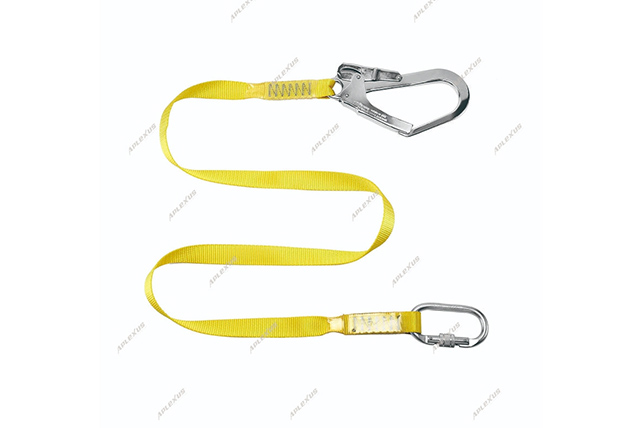
Not every D-ring on a harness has the same purpose. The location and labeling of the attachment point are important when choosing and using a harness.
The dorsal D-ring is positioned on the upper back, generally between the shoulder blades. It is commonly associated with fall arrest applications and can be used with compatible energy-absorbing lanyards or self-retracting lifelines when permitted by the harness and system design.
The location helps keep the connection point relatively central to the worker's body during a fall arrest event. However, the complete system still needs to be correctly selected and adjusted to manage fall clearance and other risks.
A front attachment point may be provided for specific applications such as controlled climbing, rescue, or other functions depending on the harness design. It should not automatically be treated as a fall arrest connection simply because it is located on the front.
Buyers should always check the manufacturer's instructions and the identification of the specific attachment point before specifying its intended use.
Side D-rings are commonly associated with work positioning applications. They may allow a worker to maintain a stable working position while using an appropriate positioning system.
Side attachment points are not interchangeable with dorsal fall arrest attachment points. A procurement specification should clearly identify whether the harness is intended for fall arrest, restraint, positioning, rescue, or a combination of applications.
A Harness D-Ring is typically manufactured from a strong metal alloy selected for mechanical performance, corrosion resistance, weight, and manufacturing requirements. Steel and aluminum alloys are among the materials that may be used in different harness designs.
Steel D-rings can provide a robust solution for demanding industrial applications, although they may add more weight. Aluminum can reduce overall product weight and may be useful when mobility and portability are important.
The material is only one part of the performance equation. The D-ring geometry, thickness, forming process, heat treatment where applicable, surface treatment, and connection between the ring and harness webbing all affect the finished component.
For products exposed to moisture, chemicals, outdoor conditions, or marine environments, corrosion resistance should also be considered. The D-ring finish should be compatible with the expected environment and the rest of the harness construction.
The manufacturing process depends on the material and design. Metal D-rings may involve forming, forging, machining, heat treatment, surface finishing, and inspection. The finished component must maintain the required geometry and mechanical properties throughout production.
The harness itself generally uses High-strength Webbing, reinforced stitching, buckles, adjustment components, and attachment points. During assembly, the D-ring is integrated into the webbing structure using a construction designed to transfer loads safely through the harness.
Stitching around the attachment area is particularly important. High-strength webbing cannot compensate for poorly controlled stitching or incorrect reinforcement. Manufacturers therefore need to control thread tension, stitch pattern, seam position, webbing alignment, and reinforcement during production.
For B2B buyers, this is one reason a product sample should be evaluated together with the supplier's production process. A prototype can confirm dimensions and configuration, but mass production also requires consistent material control and inspection.
The position of the attachment point affects how forces are transferred through the harness and how the worker's body is positioned during an event. This is why different D-rings are designed for different functions.
A Fall Arrest Harness with a dorsal attachment point may be appropriate for a fall arrest system when used according to its instructions. A harness with side attachment points may be designed for work positioning. A rescue-oriented harness may include additional connection points for specific recovery procedures.
Using an attachment point for a purpose for which it was not designed can create serious safety risks. Buyers should therefore avoid selecting a harness solely by the number of D-rings. The intended application and manufacturer-approved connection configuration are more important.
When purchasing a Full Body Safety Harness, start with the working environment and the required protection system.
Application: Determine whether the harness is intended for fall arrest, restraint, positioning, rescue, climbing, or a combination of functions.
Attachment configuration: Identify which D-rings are required and what each attachment point is designed to do.
Webbing: Check the material, width, construction, and resistance to the expected environment.
Adjustment: Ensure the harness can be properly fitted to the intended range of users.
Hardware: Evaluate buckles, D-rings, connectors, and other components according to the application.
Compatibility: Confirm that the harness can be used with the intended lanyard, lifeline, anchorage, and other components.
Inspection: Establish a practical inspection procedure for webbing, stitching, hardware, and attachment points.
A harness should also be selected according to the applicable regulations and standards for the target market. Buyers should request the manufacturer's technical documentation and verify that the product is suitable for the intended application rather than relying only on general product descriptions.
One common mistake is assuming that all D-rings provide the same function. They do not. Another is focusing only on the rated strength of the metal component without considering the entire harness assembly.
Other problems include incorrect adjustment, incompatible connectors, damaged webbing, corrosion, worn stitching, and using an attachment point outside its approved purpose.
For professional users, pre-use inspection is therefore essential. The D-ring should be checked for visible deformation, cracks, excessive corrosion, sharp edges, or other damage. The surrounding webbing and stitching should also be inspected because the complete attachment assembly needs to remain in suitable condition.
For brands sourcing Custom Safety Harness products, the D-ring configuration should be defined during the design stage. The supplier needs to understand the intended application, user range, attachment requirements, webbing specification, hardware requirements, and target market.
OEM/ODM development may involve custom webbing colors, labels, padding, hardware configurations, adjustment systems, packaging, and other product details. However, customization should not compromise the technical requirements of the safety system.
When working with a Safety Harness Supplier, buyers should request information about material specifications, manufacturing controls, inspection procedures, testing documentation, production capacity, sample development, MOQ, and lead time. For safety-critical equipment, traceability and consistent quality are especially important.
The D-ring provides an approved connection point between the harness and compatible fall protection or positioning equipment. Its specific purpose depends on its location and the manufacturer's design and instructions.
The rear dorsal D-ring is commonly designed for fall arrest applications, but users must verify the manufacturer's instructions and the specific harness configuration before use.
Side D-rings are commonly intended for work positioning rather than general fall arrest. Their approved function depends on the harness design, so they should only be used according to the manufacturer's instructions.
D-rings are commonly manufactured from steel or aluminum alloys, depending on the required strength, weight, corrosion resistance, and product design. The exact material and manufacturing specification should be confirmed with the manufacturer.
Look for a supplier with appropriate manufacturing capability, documented quality-control procedures, technical expertise, and experience producing the type of harness required. Buyers should also verify product documentation, testing information, customization capability, MOQ, and production consistency.
The D-ring is a critical connection component in a safety harness, but its function depends on its location and the design of the complete fall protection system. The dorsal D-ring is commonly associated with fall arrest, while front and side attachment points may serve different functions such as positioning, restraint, climbing, or rescue.
For B2B procurement, selecting a safety harness should involve more than checking the number of D-rings. Material selection, webbing construction, stitching, hardware quality, attachment configuration, product standards, application requirements, and manufacturing consistency all need to be considered. By working with a qualified Safety Harness Supplier and clearly defining the intended application, buyers can select a Full Body Safety Harness that is technically appropriate for their working environment and product requirements.

Aplexus Industrial Co.,Ltd Is a trusted provider of semi-finished accessories and personal protective equipment (PPE).

Business wechat
Copyright © 2026 Aplexus Industrial Co.,Ltd All rights reserved.


